In this guide
- Golden Retriever at a glance
- Feeding your Golden
- Exercise: how much do Goldens need?
- Grooming and shedding
- Common Golden Retriever health issues
- Health tests to ask the breeder for
- Golden Retriever timeline: puppy to senior
- When to call the vet
- Common mistakes with Goldens
- Training tips
- Is a Golden Retriever right for you?
A Golden Retriever needs about 1–2 hours of activity a day, brushing 3–4 times a week and carefully measured meals — they shed heavily and put on weight easily. They’re friendly, smart and great with families, and these are the habits that keep them healthy.
Golden Retriever at a glance
| Size | Males about 65–75 lb (29–34 kg); females about 55–65 lb (25–29 kg) |
| Height | Males 23–24 in (58–61 cm); females 21.5–22.5 in (55–57 cm) at the shoulder (AKC breed standard) |
| Lifespan | About 10–12 years |
| Energy | High |
| Shedding | Heavy |
| Good with families | Yes — very |
Feeding your Golden
Goldens are food lovers, and extra weight is one of the biggest health risks for the breed. Extra pounds put strain on joints that are already prone to problems — here’s how to tell if your dog is overweight.
- Choose a complete and balanced food that suits your dog’s life stage. Large-breed puppy formulas help puppies grow at a steady, healthy pace.
- An adult Golden at a healthy 60–70 lb usually needs roughly 1,300–1,700 calories a day. Use our dog feeding chart and adjust to your dog’s shape.
- Feed two measured meals a day — puppies need three or four.
- Count treats. Use part of the daily kibble as training rewards, or try low-calorie options like green beans and carrots.
- Large, deep-chested dogs can be prone to bloat. Avoid heavy exercise right before and after meals, and ask your vet about your dog’s risk.
Exercise: how much do Goldens need?
Goldens were bred to retrieve birds all day, so they need about 1–2 hours of activity a day. Mix it up:
- Brisk walks and sniff walks
- Fetch (it’s literally in the name)
- Swimming — most Goldens love water
- Training games and puzzle feeders for the brain
A bored Golden will find their own fun — usually by chewing your shoes.
Puppy tip: growing joints need gentle exercise. Avoid long runs, lots of jumping and endless stairs until your vet says your puppy’s skeleton has matured.
Grooming and shedding
Goldens have a double coat: a soft, dense undercoat and a water-resistant top coat. They shed all year, and “blow” their undercoat once or twice a year.
- Brush 3–4 times a week with a slicker brush and an undercoat rake. During heavy shedding, brush daily.
- Bathe every 1–2 months, or when they’ve rolled in something (bath frequency by coat type).
- Check and clean ears weekly. Floppy ears and swimming make Goldens prone to ear infections. Dry ears well after swimming.
- Trim nails every 3–4 weeks and brush teeth several times a week.
- Don’t shave a Golden’s coat for summer. The double coat helps protect against heat and sunburn — ask a groomer for a tidy-up instead.
Common Golden Retriever health issues
Goldens are generally healthy, but the breed is known for a few conditions. Being aware helps you spot problems early:
- Hip and elbow dysplasia — joints that don’t form properly, which can lead to arthritis. Keeping your Golden lean helps.
- Skin allergies and hot spots — itchy, red patches, often in warm weather.
- Ear infections — head shaking, scratching, a bad smell or a constant head tilt.
- Eye conditions — such as cataracts.
- Heart conditions — some lines can be affected; your vet will listen to the heart at checkups.
- Cancer — Goldens have a higher rate of some cancers than many breeds. Check your dog for new lumps regularly and show any you find to your vet.
See your vet at least once a year — twice a year for seniors — and keep vaccinations and parasite prevention up to date.
Cancer: what the research says
Cancer is the health issue Golden owners ask about most, and it’s the reason the breed has its own long-term study. The Golden Retriever Lifetime Study, run by the Morris Animal Foundation, enrolled 3,000 healthy Goldens aged six months to two years and follows them for life to look for causes. Its founding paper estimated that about 60% of the dogs in the group would develop cancer.
The cancer that worries vets most in Goldens is hemangiosarcoma, a tumor of blood-vessel cells that often grows in the spleen and can bleed inside the belly without a visible lump. The AKC lists Golden Retrievers among the higher-risk breeds and describes signs such as sudden collapse, pale gums, weakness and loss of appetite. Pale gums in a Golden that suddenly goes flat is an emergency — learn what normal looks like with our dog gum color chart.
What you can do at home:
- Do a lump check once a month. Run your hands over the whole body, including armpits, groin, tail base and between the toes. Note the size and place of anything new (a phone photo next to a coin works) and show it to your vet. Size alone doesn’t tell a harmless lump from a dangerous one; a quick needle sample often can.
- Know your dog’s gums and energy. Hemangiosarcoma is usually found when it bleeds, so noticing the change fast matters.
- Ask about a senior screening plan from about middle age. Your vet can suggest what fits your dog.
Hips and elbows: signs and the growth link
VCA Animal Hospitals names Golden Retrievers among the large breeds most affected by hip dysplasia. Signs can show in puppies a few months old but are most common between one and two years: weakness or pain in the back legs, a wobbly walk, trouble getting up, limping or avoiding stairs. Many dogs show nothing until they are older and arthritis sets in.
Growth matters. VCA cites a study in which puppies fed as much as they wanted developed hip dysplasia at about twice the rate (two-thirds) of littermates fed measured meals (one-third). That is the strongest reason not to free-feed a Golden puppy.
Elbow dysplasia often looks like a subtle front-leg limp that comes and goes, or a front paw that turns in more than normal. The OFA notes the lameness can stay subtle for a long time.
Heart: subaortic stenosis
VCA lists Golden Retrievers among the breeds most commonly affected by aortic (subaortic) stenosis, a narrowing below the heart valve that a dog is born with. Many affected dogs show no signs, and a heart murmur found at a routine puppy or adult check is often the first clue. In severe cases, signs include tiring easily, shortness of breath and fainting; VCA notes strenuous exercise appears to make sudden death more likely. If your vet hears a murmur, ask whether a cardiologist should do an echocardiogram before you start hard running or field work.
Health tests to ask the breeder for
“The parents were vet-checked” is not a health test. Ask to see results registered with the Orthopedic Foundation for Animals (OFA), which you can look up yourself on the OFA website:
| Test | Who does it | What a good result looks like |
|---|---|---|
| Hips | X-ray read by OFA radiologists | Excellent, Good or Fair. Borderline, Mild, Moderate and Severe are not passing (OFA hips) |
| Elbows | X-ray, read by OFA | “Normal.” OFA won’t certify a normal elbow before 2 years of age |
| Eyes | Board-certified veterinary ophthalmologist | A clear exam; the certificate is valid for 12 months, so it should be recent (OFA eyes) |
| Heart | Ideally a veterinary cardiologist | Normal at 12 months or older. OFA’s advanced heart clearance requires a cardiologist and an echocardiogram (OFA cardiac) |
Both parents should have these, not just one. Preliminary hip X-rays can be done from 4 months, but a final rating needs an adult dog — so be wary of a breeder whose dogs are bred before two years old with no final results.
Golden Retriever timeline: puppy to senior
| Age | Focus |
|---|---|
| 8–16 weeks | Puppy vaccines, 3–4 measured meals a day, gentle handling of ears, paws and mouth so grooming is easy later. Start puppy feeding on a large-breed puppy food |
| 4–12 months | Fastest growth. Keep your puppy lean; short play sessions instead of long runs. Teach loose-leash walking before they weigh 50 lb. Heart murmur checks at vet visits |
| 1–2 years | Hip dysplasia signs most likely to appear. Ask your vet when your dog’s growth plates have closed before starting jogging or agility. Switch to adult food when your vet suggests |
| 2–7 years | Prime years. Two meals a day, adjust portions to body shape, monthly lump checks, yearly vet visit and dental care |
| Senior (later years) | Twice-yearly vet visits. Watch for stiffness, weight change, new lumps, lower energy. Softer bedding and non-slip rugs help stiff hips |
When to call the vet
| Call today or go now | Book an appointment |
|---|---|
| Collapse, sudden weakness or pale gums | A new lump, or one that grows |
| Swollen, hard belly with retching and nothing coming up (bloat) | Limping that lasts more than a day or two, or stiffness after rest |
| Fainting, or breathing hard at rest | Head shaking, ear smell or redness |
| Eating something toxic (US: ASPCA (888) 426-4435 or Pet Poison Helpline (855) 764-7661; elsewhere, call your vet) | Constant licking of paws, red itchy skin or hot spots |
| Not able to get up or put weight on a leg | Weight gain you can’t explain, or a dull, thinning coat |
Common mistakes with Goldens
- Free-feeding a puppy. See the hip study above. Measure every meal.
- Buying on looks or price alone. A puppy from parents with no OFA results costs less up front and may cost much more later.
- Dismissing a murmur as “just a puppy thing.” Some are harmless; ask whether yours needs a cardiologist.
- Hard exercise in heat. Goldens will keep retrieving long after they should stop. Their thick coat and enthusiasm make overheating easy on warm days.
- Waiting on lumps. “It’s probably fatty” is a guess until your vet has sampled it.
Training tips
Goldens are smart and eager to please, which makes training fun. Use positive reinforcement (treats, praise, play). Focus early on:
- Loose-leash walking — a 70 lb dog pulling is no joke
- Not jumping on people
- “Leave it” — Goldens will eat anything, including socks
- Calm greetings with kids and visitors
Is a Golden Retriever right for you?
A Golden is a great fit if you have time for daily exercise, don’t mind dog hair on everything, and want a friendly, people-loving companion. If you’re away all day or want a low-shedding dog, another breed may suit you better.
Comparing retrievers? Read our Labrador Retriever care guide. Thinking about a smaller, lower-energy breed? Read our French Bulldog care guide.
Frequently asked questions
How much should a Golden Retriever eat?
An adult Golden at an ideal weight of 60–70 lb typically needs around 1,300–1,700 calories a day, depending on activity and whether they are neutered. Check the calories on your dog food bag and adjust to keep a visible waist.
Do Golden Retrievers shed a lot?
Yes. Goldens have a double coat and shed year-round, with heavier shedding once or twice a year. Regular brushing helps a lot. Never shave a Golden’s double coat unless your vet recommends it.
How long do Golden Retrievers live?
Most Golden Retrievers live around 10 to 12 years. Keeping them lean, active and up to date with vet checkups gives them the best chance at a long, healthy life.
Are Golden Retrievers good with kids?
Goldens are famously friendly and patient and are often great family dogs. Like any dog, they need training and supervision around young children, and puppies can be very mouthy and bouncy.
What health tests should a Golden Retriever puppy’s parents have?
Ask for OFA results on both parents for hips and elbows (final ratings at 2 years or older), a current eye exam by a veterinary ophthalmologist (valid 12 months) and a heart exam, ideally by a cardiologist.
Do most Golden Retrievers get cancer?
Cancer is common in the breed. The Golden Retriever Lifetime Study estimated that about 60% of its dogs would develop cancer. Monthly lump checks and fast action on pale gums or collapse help catch problems.
Sources
- American Kennel Club — Golden Retriever breed page
- The Golden Retriever Lifetime Study (Phil. Trans. R. Soc. B, 2015)
- Orthopedic Foundation for Animals — Hip Dysplasia
- VCA Animal Hospitals — Ear Infections in Dogs
We summarize what these organizations publish in plain English. How we write and check our guides.
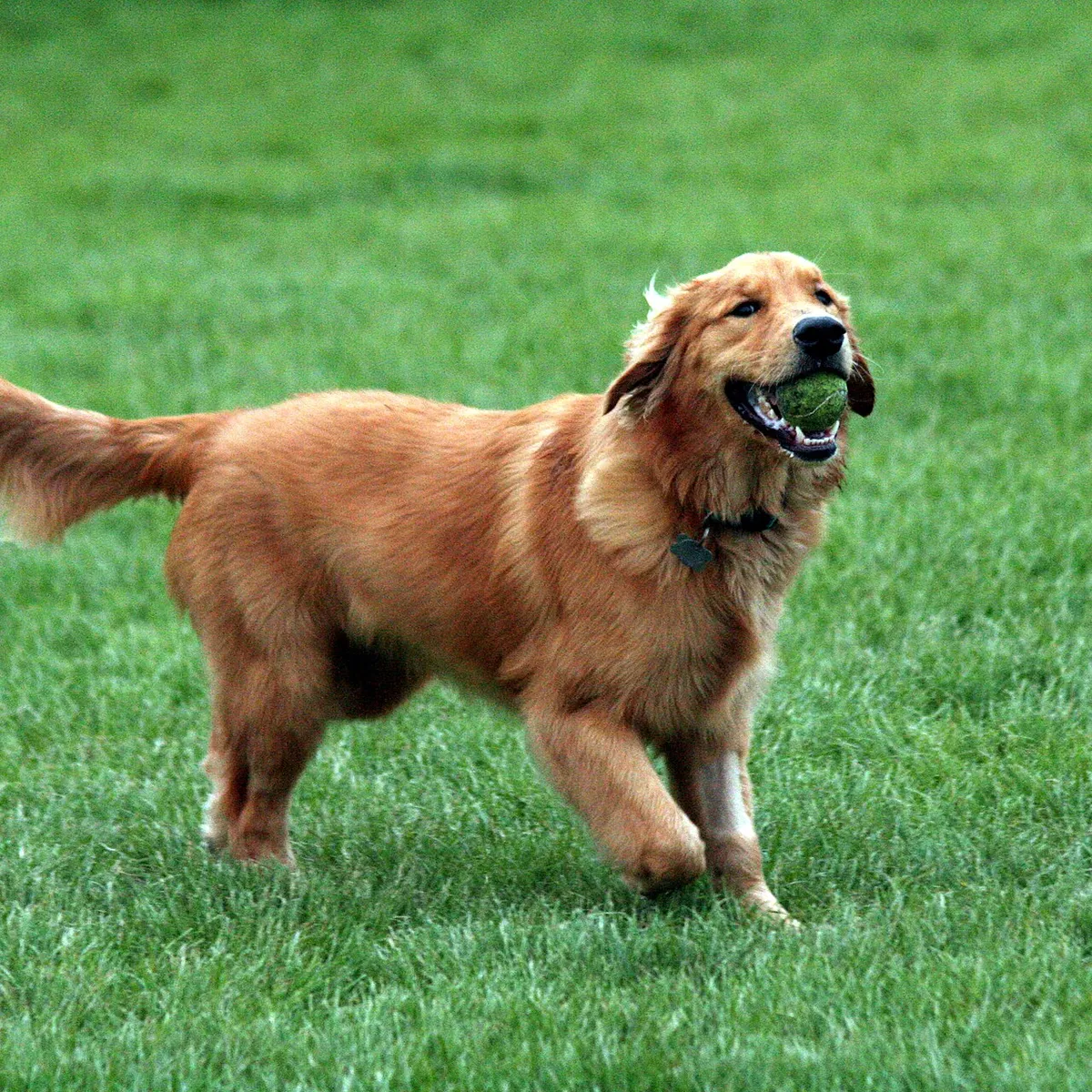
Photo: “Golden Retriever with tennis ball” by Scott Beckner, CC BY 2.0, cropped.

Not a substitute for your vet
This guide is general information for healthy adult dogs. Every dog is different — age, size, allergies and health conditions all matter. Ask your veterinarian before changing your dog’s diet or care.
Possible poisoning? US: ASPCA Animal Poison Control (888) 426-4435 or Pet Poison Helpline (855) 764-7661 (fees may apply). Elsewhere: call your vet or nearest emergency animal hospital right away.
 Up next French Bulldog Care Guide: Heat, Breathing, Food & Wrinkles
Save this for later — pin it to your dog board so you can find it fast.
Pin itKeep reading
-
Why Do Dog Paws Smell Like Fritos?
That corn-chip smell from your dog’s paws is usually normal bacteria and yeast. Here’s why it happens, how to keep paws clean and when to call the vet.
Usually normal bacteria & yeast -

Can Dogs Eat Bananas? Yes.
Bananas are a safe, healthy treat for most dogs in small amounts. How much to give by size, how to serve it, and when to skip it.
Small dog: 1–2 slices · Large: ½ banana -
Can Dogs Eat Cheese?
Most dogs can have small pieces of plain cheese. Which cheeses are better, which to avoid, how much to give and when cheese is a bad idea.
Pea-sized pieces of plain cheese