In this guide
- Step 1: Start with the food label
- Step 2: Check the rough calorie chart
- Step 3: Turn calories into cups
- Step 4: Do the body check every 2–3 weeks
- When the bag and the math don’t agree
- Mixing wet and dry food: the math
- How often should I feed my dog?
- Feeding myths vs reality
- Common feeding mistakes
- Picky eater, or something else?
- When to talk to your vet
A typical neutered adult dog needs roughly 350 calories a day at 10 lb (4.5 kg), 790 at 30 lb (13.6 kg) and 1,160 at 50 lb (22.7 kg). Start with the feeding guide on your food bag, then adjust to your dog’s body shape — size, age, activity and the food itself all change the number.
This guide gives you a simple starting point and an easy way to fine-tune it.
Step 1: Start with the food label
Every complete dog food has a feeding guide on the bag or can. It’s based on the calories in that specific food, so it’s the best place to start.
Two tips:
- Feeding guides tend to be on the generous side. Many dogs — especially less active or neutered dogs — need a bit less.
- Look for the calories per cup or per can (where to find it on the label) (shown as kcal/cup or kcal/can). Calories vary a lot between brands, so “2 cups” of one food is not the same as 2 cups of another.
Step 2: Check the rough calorie chart
Here are rough daily calorie estimates for healthy adult dogs at an ideal weight, based on a common veterinary formula. Real needs can be 20–30% higher or lower, depending on the dog.
| Dog’s ideal weight | Neutered/spayed adult | Intact (not neutered) adult |
|---|---|---|
| 5 lb (2.3 kg) | ~210 kcal | ~230 kcal |
| 10 lb (4.5 kg) | ~350 kcal | ~390 kcal |
| 20 lb (9 kg) | ~590 kcal | ~660 kcal |
| 30 lb (13.6 kg) | ~790 kcal | ~890 kcal |
| 40 lb (18 kg) | ~990 kcal | ~1,110 kcal |
| 50 lb (22.7 kg) | ~1,160 kcal | ~1,310 kcal |
| 60 lb (27 kg) | ~1,340 kcal | ~1,500 kcal |
| 70 lb (32 kg) | ~1,500 kcal | ~1,690 kcal |
| 80 lb (36 kg) | ~1,660 kcal | ~1,860 kcal |
| 100 lb (45 kg) | ~1,960 kcal | ~2,200 kcal |
How it’s calculated: resting energy = 70 × (weight in kg)0.75, multiplied by about 1.6 for neutered adults and 1.8 for intact adults. Very active or working dogs need more. Senior, inactive and overweight dogs usually need less. Puppies, pregnant and nursing dogs have very different needs — follow your vet’s advice and the puppy food label, and see our puppy feeding schedule.
Important: use your dog’s ideal weight, not their current weight, if they need to lose or gain.
Activity moves the number more than breed does
Two 50 lb dogs can need very different amounts. The same formula with the factors our dog food calculator uses — 1.3 for inactive or senior adults, 1.6 for a typical neutered adult, 2.0 for very active dogs:
| Ideal weight | Resting energy (RER) | Inactive / senior (×1.3) | Typical neutered (×1.6) | Very active (×2.0) | Treat budget (10% of typical) |
|---|---|---|---|---|---|
| 10 lb (4.5 kg) | 218 kcal | 283 kcal | 348 kcal | 435 kcal | ~35 kcal |
| 25 lb (11.3 kg) | 433 kcal | 562 kcal | 692 kcal | 865 kcal | ~70 kcal |
| 50 lb (22.7 kg) | 727 kcal | 946 kcal | 1,164 kcal | 1,455 kcal | ~115 kcal |
| 75 lb (34 kg) | 986 kcal | 1,282 kcal | 1,578 kcal | 1,972 kcal | ~160 kcal |
| 100 lb (45.4 kg) | 1,223 kcal | 1,591 kcal | 1,958 kcal | 2,447 kcal | ~195 kcal |
Check one row yourself: 50 lb ÷ 2.2046 = 22.7 kg. 22.70.75 ≈ 10.4, and 70 × 10.4 ≈ 727 kcal. Multiply by 1.6 and you get 1,164 kcal.
“Very active” means real work — daily runs, agility, hiking, herding — not two leash walks around the block. Most pet dogs belong in the inactive or typical column.
Step 3: Turn calories into cups
Divide the daily calories by the kcal per cup on your bag. For example:
- Your dog needs about 800 kcal a day
- Your food has 400 kcal per cup
- 800 ÷ 400 = 2 cups a day, split into two meals of 1 cup
Don’t forget treats: subtract them from the total. Treats should be no more than about 10% of daily calories.
Use a real measuring cup or a kitchen scale. A “scoop” or a coffee mug can easily be 25% more than you think.
Worked example: a 25 lb Beagle, by cup and by gram
Meet a spayed, moderately active Beagle with an ideal weight of 25 lb. Her food lists 350 kcal/cup and 3,500 kcal/kg.
- Daily calories: 433 (RER) × 1.6 = about 692 kcal.
- Set aside treats: keep 10% for extras → 692 × 0.9 = about 623 kcal from food.
- Cups: 623 ÷ 350 = 1.78 cups a day — call it 1¾ cups, or a little under 7/8 cup per meal.
- Grams: 3,500 kcal/kg = 3.5 kcal per gram. 623 ÷ 3.5 = 178 g a day, or 89 g per meal.
Why a level cup isn’t always a cup
The kcal/cup on a bag assumes a standard 8 fl oz measuring cup filled exactly level, as Tufts’ Petfoodology team explains. They also note that measuring by volume often leads to over- or underfeeding, especially with big kibble that won’t sit level. Their fix is to weigh the food in grams using the kcal/kg figure on the label.
Small errors add up. If the Beagle above gets just ¼ cup extra per meal, that’s 2 × ¼ × 350 = 175 kcal a day — about 28% more than her food target.
Step 4: Do the body check every 2–3 weeks
The best feeding guide is your dog’s body. Check these three things:
- Ribs: you should be able to feel them easily under a thin layer of fat, without pressing hard — but not see them sticking out.
- Waist from above: looking down, there should be a visible waist behind the ribs.
- Tummy tuck from the side: the belly should slope up from the chest towards the back legs.
- Not sure? Try the 3 quick checks in our overweight guide.
- Can’t feel the ribs and no waist? Cut portions by about 10% and recheck in a few weeks.
- Ribs, hips and spine very visible? Increase by about 10% and talk to your vet.
Adjust slowly. Sudden, big changes can upset the stomach.
When the bag and the math don’t agree
For a Petfoodology post on feeding directions, a Tufts nutritionist compared 8 dry adult foods against standard calorie calculations. One brand’s directions gave up to 61% more calories than a typical neutered adult dog would need.
How to settle it:
- Start with the lower of the two numbers if your dog is neutered and not very active.
- Weigh your dog and do the body check after 2–3 weeks.
- Let the body decide. If the ribs are disappearing, cut about 10%. If the hips start to show, add about 10%.
- Watch the 75% line. The same Tufts post advises that if you end up feeding less than 75% of the label amount, you should move to a lower-calorie or weight-management food. Cutting a regular food too far can leave a dog short on vitamins and minerals.
Calorie density is the reason one rule can’t fit every bag. Tufts notes that dry over-the-counter dog foods range from about 300 to over 700 kcal per cup, while refrigerated or frozen cooked foods are often under 200 kcal per cup.
Mixing wet and dry food: the math
Toppers have calories too. Count them like this, using a 50 lb neutered dog (about 1,164 kcal a day):
| Step | Calculation | Result |
|---|---|---|
| Daily target | from the table above | 1,164 kcal |
| Leave 10% for treats | 1,164 × 0.9 | ~1,048 kcal |
| Wet food (example: can labeled 400 kcal, half a can a day) | 400 × 0.5 | 200 kcal |
| Calories left for kibble | 1,048 − 200 | 848 kcal |
| Kibble at 400 kcal/cup | 848 ÷ 400 | ~2⅛ cups a day |
Swap in the kcal/can and kcal/cup from your own labels — canned foods vary as much as dry ones. If you move wet food from “topper” to half the diet, redo the whole calculation.
How often should I feed my dog?
| Age | Meals per day |
|---|---|
| Puppies (8–12 weeks) | 4 |
| Puppies (3–6 months) | 3 |
| Puppies (6–12 months) and adults | 2 |
| Senior dogs | 2 (or as your vet suggests) |
Large and giant breeds may do better with two or more smaller meals and a calm rest after eating. Ask your vet about bloat risk if you have a deep-chested breed like a Great Dane or German Shepherd.
Feeding myths vs reality
| Myth | Reality |
|---|---|
| “My dog acts hungry, so they need more.” | Appetite isn’t a calorie meter. Many dogs, Labs especially, will happily eat far more than they burn. Use the rib check, not the begging. |
| “Big dogs need proportionally more.” | Energy needs rise more slowly than weight (that’s the 0.75 power). A 100 lb dog needs about 5.6× the calories of a 10 lb dog, not 10×. |
| “Neutering doesn’t change anything.” | Standard formulas give neutered adults a lower factor (1.6 vs 1.8). Same weight, about 11% fewer calories. |
| “Grain-free or ‘light’ means fewer calories.” | Only the kcal number on the label tells you that. Compare kcal/cup, not marketing claims. If you’re weighing grain-free, see is grain-free dog food bad. |
Common feeding mistakes
- Guessing portions instead of measuring
- Forgetting treats and table scraps — they add up fast
- Free-feeding (leaving food out all day)
- Feeding for the puppy long after your dog has finished growing
- Switching foods suddenly — mix new food in gradually over about 7 days
- Keeping the same scoop after changing brands — if the new food has 100 kcal more per cup, 2 cups a day is 200 extra kcal
- Dividing by the wrong unit — mixing up kcal/kg (a four-digit number such as 3,750) with kcal/cup gives absurd portions, so sanity-check the answer
- Counting meals but not chews — dental sticks, bully sticks and pill pockets all belong in the 10% treat budget
Picky eater, or something else?
Not every dog lives to eat. In a Petfoodology post on food motivation, Tufts nutritionist Lisa Freeman notes that many Standard Poodles “eat to live,” while most Labs do the opposite. A dog that eats less than the chart says can be healthy if their weight is steady, energy is normal, body condition score is at least 3–4 out of 9 and there’s no muscle loss over the back. See the vet if the picky eating is new, it started after a food change or a new bag, there are other signs like tiredness or weakness, the dog is losing weight without trying, or the body condition score is under 4.
When to talk to your vet
Ask your vet for a personal feeding plan if your dog is a puppy, senior, pregnant, very active, overweight, underweight, or has any health condition. Also call if your dog suddenly eats much more or much less than usual, or loses or gains weight without a clear reason.
Looking for healthy extras? Try our 3-ingredient frozen dog treats or see 15 human foods dogs can eat.
Frequently asked questions
How many times a day should I feed my dog?
Most adult dogs do well on two meals a day, about 8–12 hours apart. Puppies usually need three to four smaller meals a day. Your vet may suggest a different schedule for some health conditions.
How many cups of food should my dog eat?
It depends on the food, because calories per cup vary widely between brands. Check the calories per cup on the bag (listed as kcal/cup) and the feeding guide, then adjust to your dog’s body condition.
Is it bad to free-feed my dog?
Leaving food out all day makes it hard to know how much your dog eats and often leads to weight gain. Measured meals at set times are easier to manage for most dogs.
Why is my dog always hungry?
Many dogs, especially breeds like Labradors, are naturally food-motivated. But a sudden increase in hunger can be a sign of a medical issue, so mention it to your vet.
Is it better to weigh dog food or use a measuring cup?
Weighing is more accurate. Find the kcal/kg on the label, divide by 1,000 to get calories per gram, then divide your dog’s daily calories by that number to get grams per day.
If I add wet food, how much kibble do I take away?
Subtract the wet food’s calories from the daily total, then divide what’s left by the kibble’s kcal per cup. Half a 400 kcal can, for example, replaces about half a cup of a 400 kcal/cup kibble.
Sources
- WSAVA Global Nutrition Guidelines
- Petfoodology — Cummings School of Veterinary Medicine at Tufts University
- Petfoodology (Tufts) — How Accurate Are Your Pet Food’s Feeding Directions?
- Association for Pet Obesity Prevention
We summarize what these organizations publish in plain English. How we write and check our guides.
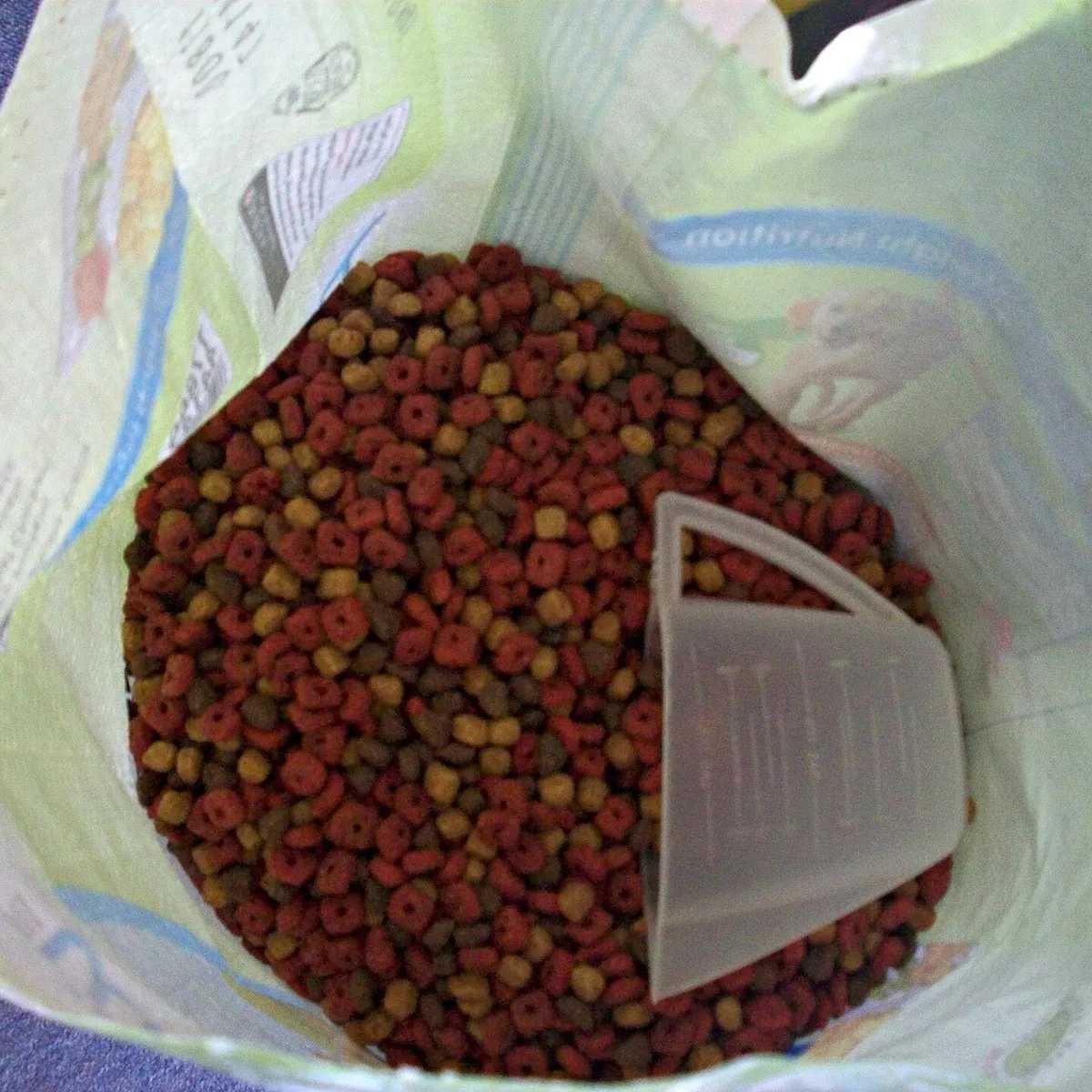
Photo: “Dog Food (1)” by Alisha Vargas, CC BY 2.0, cropped.

Not a substitute for your vet
This guide is general information for healthy adult dogs. Every dog is different — age, size, allergies and health conditions all matter. Ask your veterinarian before changing your dog’s diet or care.
Possible poisoning? US: ASPCA Animal Poison Control (888) 426-4435 or Pet Poison Helpline (855) 764-7661 (fees may apply). Elsewhere: call your vet or nearest emergency animal hospital right away.
 Up next Is My Dog Overweight? 3 Quick Checks (and What to Do)
Save this for later — pin it to your dog board so you can find it fast.
Pin itKeep reading
-
3-Ingredient Frozen Dog Treats
Easy homemade frozen dog treats with just 3 ingredients and 10 minutes of prep. Plus safe swaps, portion tips and how long they keep.
Pumpkin + peanut butter + yogurt -

Labrador Retriever Care Guide
Labs need about an hour or more of exercise a day, carefully measured meals and weekly ear checks. Feeding, exercise, shedding and health watch-outs for Labrador owners.
Measure every meal — Labs love food -

Can Dogs Eat Bananas? Yes.
Bananas are a safe, healthy treat for most dogs in small amounts. How much to give by size, how to serve it, and when to skip it.
Small dog: 1–2 slices · Large: ½ banana