In this guide
Turn the bag around and check the nutritional adequacy statement first: it should say the food is “complete and balanced” for your dog’s life stage. Then find the calories per cup. Those two lines tell you more than any photo or slogan on the front.
1. The nutritional adequacy statement (most important)
It’s a small sentence, usually near the guaranteed analysis. In the US it looks like:
“[Brand] is formulated to meet the nutritional levels established by the AAFCO Dog Food Nutrient Profiles for adult maintenance.”
or, for feeding trials: “Animal feeding tests using AAFCO procedures substantiate that [Brand] provides complete and balanced nutrition for…”
What to look for:
| Statement says | Means |
|---|---|
| Adult maintenance | For adult dogs only |
| Growth / gestation & lactation | For puppies and pregnant or nursing dogs |
| All life stages | Meets puppy needs, so OK for any age |
| …including growth of large size dogs (70 lb or more as an adult) | Suitable for large-breed puppies |
| “Intermittent or supplemental feeding only” | Not a complete diet — treat or topper only |
Formulated, feeding-tested or “family”: what each wording proves
The AAFCO label guide recognizes a few ways a company can back up “complete and balanced,” and the wording tells you which one it used:
- “Formulated to meet… AAFCO Dog Food Nutrient Profiles” — the recipe was designed, and analyzed, to hit every nutrient level in the profile. No dogs had to eat it for this claim.
- “Animal feeding tests using AAFCO procedures substantiate…” — the food was fed to a group of dogs under a set protocol and they stayed healthy on it. It shows dogs eat it and do well over the test period.
- “Comparable to a product which has been substantiated using AAFCO feeding tests” — a “family” claim: a close cousin of a recipe that passed a trial. AAFCO says it’s rarely used.
AAFCO doesn’t rank one above the other, and neither should you on that basis alone. A formulated food from a company with a nutritionist and solid quality control can be an excellent choice. What matters is that one of these sentences is there, and that it names your dog’s life stage. The FDA notes that seals or endorsements from other groups are not proof of nutritional adequacy — the AAFCO statement is.
Two more things the statement tells you. The FDA’s explainer on complete and balanced food points out that adult maintenance foods carry lower levels of some nutrients than growth foods, to avoid unnecessary excess — so an “all life stages” food isn’t automatically the better pick for a sedentary adult. And treats and snacks don’t need a nutritional adequacy statement at all, as long as “treat” or “snack” is clearly on the front.
2. Calories
Look for “Calorie content (calculated)” in kcal/kg and kcal/cup (or per can). This is the number that tells you how much to feed — calories per cup can differ by more than 150 kcal between brands. Plug it into our dog food calculator, then read how much to feed your dog.
AAFCO requires the calorie statement under a “Calorie Content” heading, in kcal per kg as fed plus a household unit like a cup or can. Two related rules are worth knowing:
- “Lite,” “light” or “low calorie” has a ceiling. For dry dog food, AAFCO caps it at 3,100 kcal/kg. The AKC adds that “lite” and “reduced calorie” claims must state the percentage reduction and name the product being compared. A “healthy weight” bag without those numbers may not be lower in calories than your current food.
- Feeding directions are a starting point. AAFCO requires them to say how much to feed per body weight per day, but the AKC calls them guidelines, not rules. Many indoor, neutered adults need less than the bag says. Watch your dog’s waist, not the chart on the bag.
Price per bag vs price per 1,000 kcal
Bags come in different sizes and calorie densities, so the price per pound can point you the wrong way. Divide the price by the calories in the bag instead. Example with made-up prices:
| Bag A | Bag B | Canned | |
|---|---|---|---|
| Size | 30 lb (13.6 kg) | 24 lb (10.9 kg) | 13 oz (369 g) |
| Price | $60 | $52 | $3.20 |
| Calorie content | 3,600 kcal/kg | 4,100 kcal/kg | 1,050 kcal/kg |
| Calories in the package | 48,988 kcal | 44,633 kcal | 387 kcal |
| Price per lb | $2.00 | $2.17 | — |
| Price per 1,000 kcal | $1.22 | $1.17 | $8.27 |
| Cost for a dog eating 1,200 kcal/day, 30 days | $44.09 | $41.94 | $297.70 |
How it’s calculated for Bag A: 30 lb × 0.4536 = 13.61 kg; 13.61 × 3,600 = 48,988 kcal; $60 ÷ 48.988 = $1.22 per 1,000 kcal. Bag B costs more per pound but less per calorie, because you scoop less of it. The canned line shows why many owners use wet food as a topper rather than the whole diet — and why you have to cut back the kibble when you add it.
3. The name rules
In the US, the wording of the product name tells you roughly how much of the named ingredient is inside:
| Name on the bag | Named ingredient must be (not counting water for processing) |
|---|---|
| “Beef Dog Food” | at least 95% of the product |
| “Beef Dinner,” “Platter,” “Entrée,” “Formula” | at least 25% |
| “Dog Food with Beef” | at least 3% |
| “Beef Flavor” | enough to be detected — can be a tiny amount |
The fine print behind those percentages
The table uses the headline numbers. AAFCO’s rules add a few details that change how you read a name:
- Water is counted separately. A “Beef Dog Food” must be 95% beef not counting added water, and at least 70% beef once water is counted. A “Beef Dinner” needs 25% without water and at least 10% with it.
- Two named ingredients share the percentage. In “Chicken and Liver Dinner,” the two together must make 25%, each must be at least 3%, and they must be named in the same order as on the ingredient list. So there is more chicken than liver.
- “All” or “100%” (as in “All Beef Jerky Treats”) means the product is the named meat apart from processing water, small amounts of preservatives and a few permitted additives.
- A “flavor” has to come from a listed ingredient, and the word “flavor” must be printed as large as the flavor name. If the beef on the front of “Beef Flavor” only shows up as “beef broth” or “beef digest” far down the list, that’s legal.
Read the name, then confirm it against the ingredient list. A “Salmon & Rice Entrée” where salmon appears fourth on the list deserves a closer look.
4. The ingredient list
Ingredients are listed by weight before cooking. Fresh meat is about 70% water, so it can be first on the list while contributing less protein than a dry ingredient lower down. Don’t judge a food by its first three ingredients alone.
Things worth knowing:
- “Meal” (e.g., chicken meal) is a concentrated, dried ingredient — not a bad sign.
- “By-products” can include nutritious organ meats.
- Grain-free isn’t automatically healthier — see is grain-free dog food bad?
5. The guaranteed analysis
It lists minimum protein and fat and maximum fiber and moisture, as fed. To compare a dry food with a canned food, you need to remove the water:
Dry-matter protein = protein % ÷ (100 − moisture %) × 100
Example: canned food with 8% protein and 78% moisture → 8 ÷ 22 × 100 = 36% protein on a dry-matter basis — higher than many dry foods with 26% on the label.
Worked example: dry vs canned, done two ways
Dry matter fixes the water problem, but not the calorie problem. Tufts’ veterinary nutrition team at Petfoodology recommends going one step further and comparing grams of nutrient per 100 kcal — because your dog eats a set number of calories, not a set weight of food. Here are two labels:
| Dry food | Canned food | |
|---|---|---|
| Crude protein (min) | 25% | 8% |
| Moisture (max) | 10% | 78% |
| Calories | 3,606 kcal/kg | 1,198 kcal/kg |
Step 1 — dry matter. Dry: 25 ÷ (100 − 10) × 100 = 25 ÷ 90 × 100 = 27.8%. Canned: 8 ÷ (100 − 78) × 100 = 8 ÷ 22 × 100 = 36.4%. On this basis the canned food looks much richer in protein.
Step 2 — per 100 kcal. Divide the protein percentage by the calories per kg, then multiply by 1,000. Dry: 25 ÷ 3,606 × 1,000 = 6.9 g per 100 kcal. Canned: 8 ÷ 1,198 × 1,000 = 6.7 g per 100 kcal.
Check the math the long way: 100 g of the dry food holds 25 g of protein and 360.6 kcal, and 25 ÷ 3.606 = 6.93 g per 100 kcal. 100 g of the canned food holds 8 g of protein and 119.8 kcal, and 8 ÷ 1.198 = 6.68 g. Same answer.
Per calorie — the way your dog actually eats it — the two foods deliver almost the same protein. The canned food only looked higher on dry matter because each gram of its dry matter carries fewer calories (from less fat, more fiber, or both). Keep in mind that label figures are minimums and maximums, so the real values can be somewhat different; the manufacturer can give you typical values if you ask.
Bonus: who makes it?
Look for the manufacturer’s name and a phone number or website. Veterinary nutrition guidelines suggest asking companies who formulates their diets (ideally a board-certified veterinary nutritionist or a PhD animal nutritionist) and what quality-control testing they do. A good company answers.
Label myths, checked against the rules
| Myth | What the rules actually say |
|---|---|
| “Crude protein” means low-quality protein | “Crude” is the lab method: nitrogen is measured and multiplied by 6.25. It says nothing about the source (AAFCO) |
| The guaranteed analysis shows what’s in the food | It shows a minimum for protein and fat and a maximum for fiber and moisture. The real amounts can be higher or lower |
| “Organic” on a dog food means nothing | Organic claims must meet the USDA National Organic Program, the same program as human food (AKC) |
| “Natural” means organic | Different claims. “Natural” generally means no artificial flavors, colors or preservatives; it says nothing about how ingredients were farmed |
| A vet association seal or award means the food is complete | The FDA says endorsements aren’t proof of nutritional adequacy. Look for the AAFCO statement |
| Treats are fine because they’re “made with real chicken” | Most treats are not complete and balanced. Keep them to a small share of daily calories so they don’t push out the main food |
| A bag is fine until it runs out | Check the best-by date and keep the bag closed. The AKC warns that old food can lose nutritional value or grow mold and bacteria |
Front-of-bag words that mean little
“Premium,” “holistic,” “human-grade” (unless fully qualified), “ancestral” and “natural” are mostly marketing. Some have loose rules; none tell you the food is right for your dog. Use the five checks above instead — and ask your vet if your dog has a medical condition, food allergies or is a growing puppy.
Frequently asked questions
What does “complete and balanced” mean?
It means the food is formulated (or tested in feeding trials) to provide all the nutrients a dog needs for the stated life stage, following AAFCO nutrient profiles in the US. Without it, the food is meant only as a treat or supplement.
Is a food with meat as the first ingredient better?
Not necessarily. Ingredients are listed by weight before processing, and fresh meat is mostly water. A food can list chicken first and still contain more protein from other ingredients. Overall nutrition and the company’s quality control matter more.
What is “all life stages” food?
It meets the nutrient needs of growing puppies, so it can be fed to any age. For large-breed puppies, look for a statement that includes growth of large-size dogs (70 lb or more as an adult).
What about Australian pet food labels?
In Australia, many manufacturers follow the Australian Standard for pet food (AS 5812). The same checks still help: life-stage statement, calories, ingredients and contact details.
How do I compare the price of two dog foods?
Work out the price per 1,000 kcal: multiply the bag weight in kg by the kcal/kg on the label, then divide the price by that total and multiply by 1,000. A bag that costs more per pound can be cheaper per calorie.
What does “lite” mean on dog food?
Under AAFCO rules, a lite or low-calorie dry dog food can have no more than 3,100 kcal per kg, and a reduced-calorie claim must state the percentage reduction and the product it is compared with.
Sources
- AAFCO — Reading Pet Food Labels
- U.S. FDA — “Complete and Balanced” Pet Food
- U.S. FDA — Pet Food
- Petfoodology — Cummings School of Veterinary Medicine at Tufts University
We summarize what these organizations publish in plain English. How we write and check our guides.
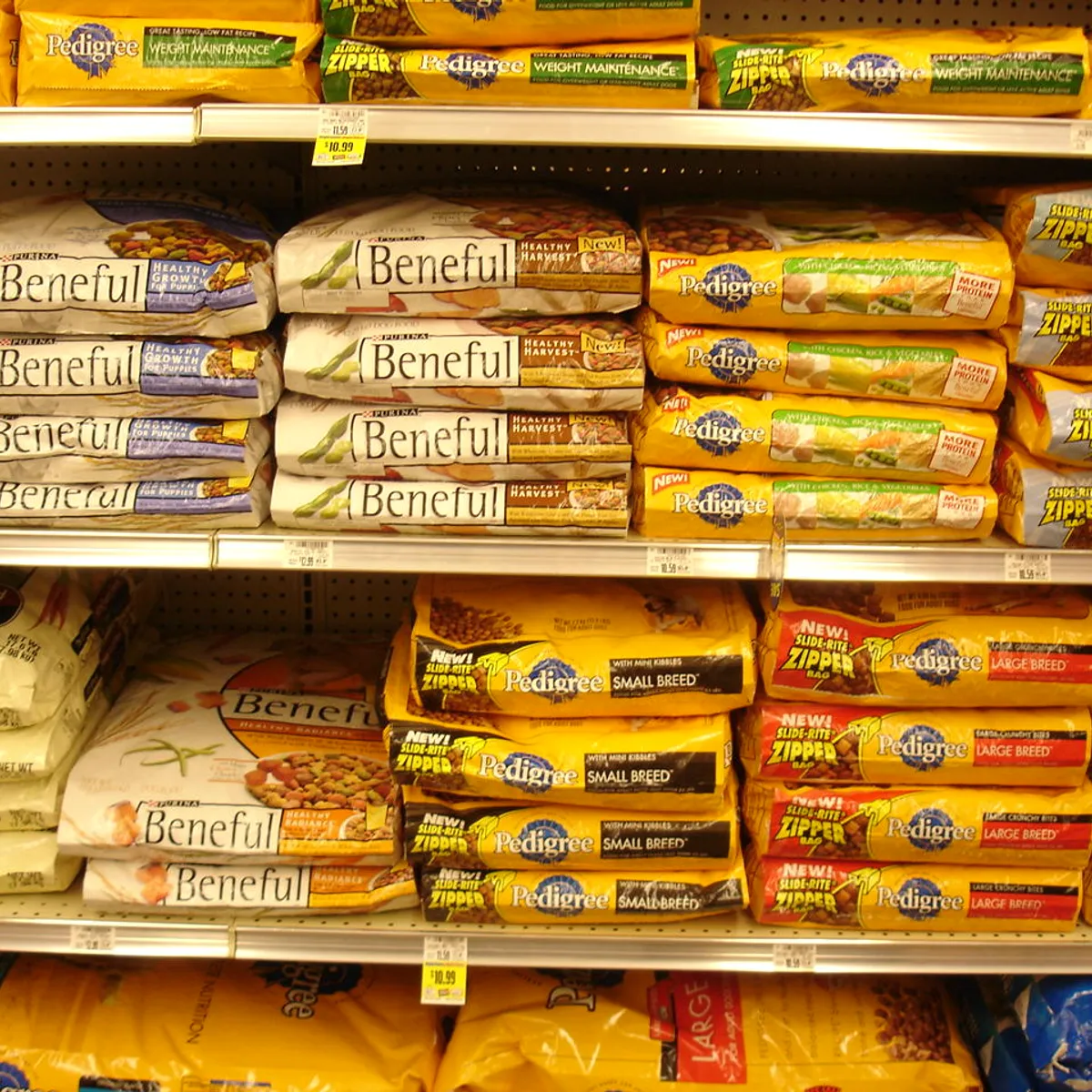
Photo: “Bags of Beneful and Pedigree dog food on shelves 2006” by Jason Meredith, CC BY 2.0, cropped.

Not a substitute for your vet
This guide is general information for healthy adult dogs. Every dog is different — age, size, allergies and health conditions all matter. Ask your veterinarian before changing your dog’s diet or care.
Possible poisoning? US: ASPCA Animal Poison Control (888) 426-4435 or Pet Poison Helpline (855) 764-7661 (fees may apply). Elsewhere: call your vet or nearest emergency animal hospital right away.
 Up next Is Grain-Free Dog Food Bad? 6 Myths vs. Facts
Save this for later — pin it to your dog board so you can find it fast.
Pin itKeep reading
-

3-Ingredient Frozen Dog Treats
Easy homemade frozen dog treats with just 3 ingredients and 10 minutes of prep. Plus safe swaps, portion tips and how long they keep.
Pumpkin + peanut butter + yogurt -

How Often Should You Bathe Your Dog?
Most dogs need a bath every 4–8 weeks, but coat type changes everything. A chart by coat, signs it’s time, and how to bathe without drying the skin.
Most dogs: every 4–8 weeks -

How Often to Clean a Dog’s Water Bowl
Wash your dog’s water bowl daily with hot soapy water. Why the slimy film forms, the best bowl materials and how much water dogs need.
Wash it daily — slime is bacteria